




Backup Power for Just-in-Time Manufacturing: What our service area Facilities Need to Know
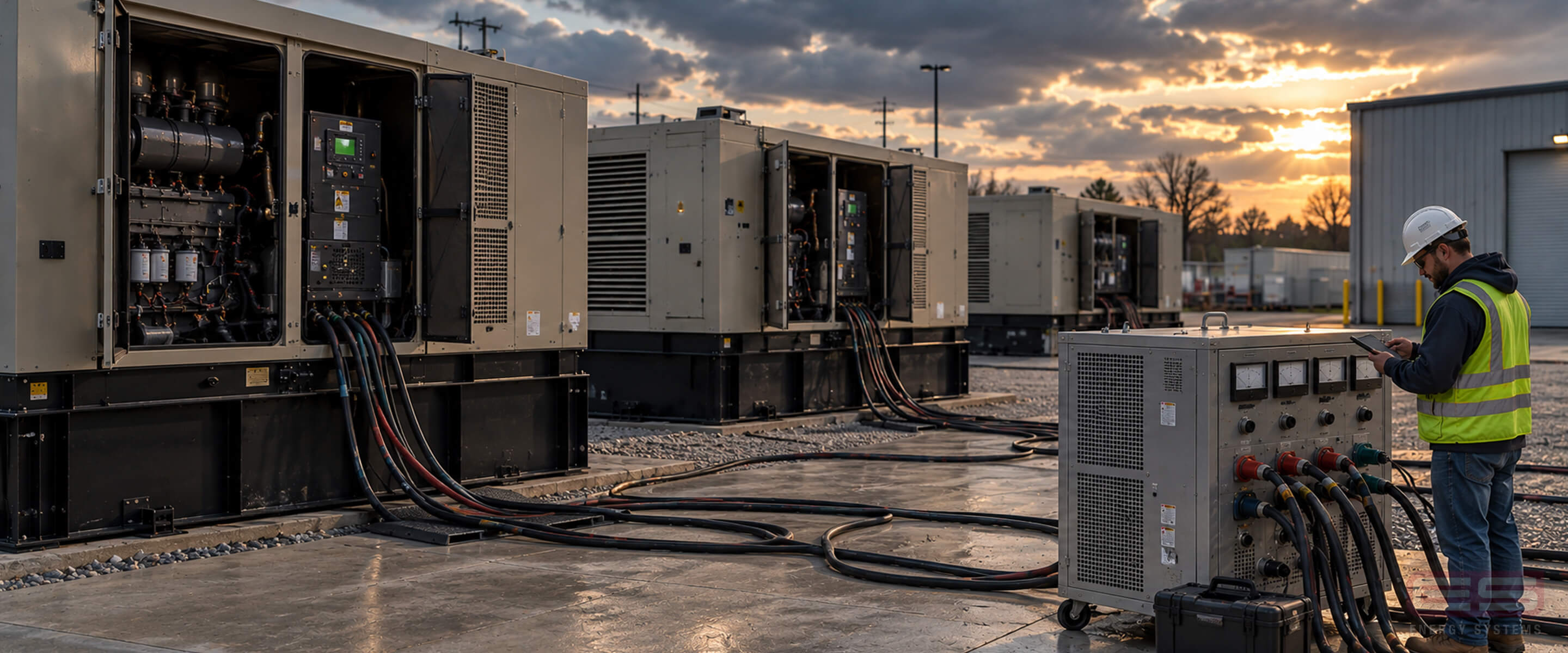
Just-in-time manufacturing doesn't forgive interruptions.
When production runs lean—minimal inventory, tight delivery windows, synchronized supply chains—a power disruption doesn't just pause operations. It triggers a chain reaction: scrap product, missed shipments, line stoppages at customer facilities, and damage to precision equipment mid-cycle.
For our service area manufacturers supplying automotive OEMs, food processors running temperature-sensitive operations, or advanced manufacturers operating CNC equipment and robotic assembly lines, power reliability isn't a nice-to-have. It's a fundamental operational requirement.
This guide covers what JIT manufacturing facilities need to understand about backup power—from the types of power events that cause the most damage, to generator sizing, transfer switch selection, and power quality considerations for sensitive production equipment.
Why JIT Manufacturing Is Uniquely Vulnerable to Power Disruptions
Traditional manufacturing with buffer inventory can absorb a short power interruption. Production pauses, inventory covers the gap, shipments go out on time. The disruption is contained.
JIT operations work differently. By design, they carry minimal work-in-process and finished goods inventory. That efficiency—the same efficiency that reduces carrying costs and improves cash flow—creates a direct dependency on continuous production. When production stops, there's nothing in reserve to cover the gap.
The vulnerability compounds across the supply chain. our automotive manufacturing ecosystem is tightly interdependent. A Tier 2 supplier that misses a shipment doesn't just affect their direct customer—it can trigger stoppages at Tier 1 assembly operations and, in severe cases, disruptions at final assembly plants. Modern automotive supply agreements often include provisions for expedited delivery costs, quality holds, and downtime charges that flow back through the supply chain.
Food processing operations face a different but equally pressing version of this problem. Temperature-sensitive products in process during a power disruption may need to be scrapped entirely. Cold chain integrity depends on continuous refrigeration. USDA and FDA compliance requirements add regulatory consequence to what is already a significant financial loss.
Advanced manufacturing—precision machining, robotic assembly, electronic component manufacturing—faces a third concern: equipment damage. CNC machines interrupted mid-cycle, robotic arms frozen in motion, PLCs that lose state—these aren't just downtime events. They can require extensive re-homing, recalibration, and quality verification before production can safely resume.
Understanding the Types of Power Events That Affect Manufacturing
Not all power problems look the same, and backup generator systems address them differently.
Extended Outages
The most visible power event—when the lights go out and stay out. our power grid is susceptible to ice storms, severe summer thunderstorms, and wind events. Extended outages lasting several hours or multiple days are not unusual following significant weather events. A properly sized standby generator with automatic transfer capability addresses extended outages directly.
Momentary Interruptions and Voltage Sags
These short-duration events—lasting fractions of a second to a few seconds—are often more damaging to manufacturing operations than extended outages. Voltage sags occur when large motors start, when utility faults occur upstream, or during grid switching operations. Many PLCs, servo drives, and CNC controllers will fault or lose program state during a momentary interruption, even if a generator is present. Addressing momentary interruptions requires different solutions: uninterruptible power supplies (UPS), ride-through devices, or battery energy storage systems in combination with generators.
Voltage Transients and Power Quality Issues
Sensitive manufacturing equipment—particularly electronics assembly, precision measurement systems, and robotic controllers—can be affected by power quality events that never trip a circuit breaker. Voltage spikes, harmonic distortion from variable frequency drives, and ground faults can cause intermittent faults, premature component failure, and data corruption. A generator alone doesn't solve power quality problems. A comprehensive power protection strategy may include filtering, isolation transformers, and proper grounding in addition to backup generation.
Understanding which type of event is most likely to affect your operation is the first step toward selecting the right backup power solution.
Generator Sizing for Manufacturing Operations
Manufacturing facilities present some of the most challenging generator sizing scenarios in commercial power. Several factors make industrial generator sizing more complex than typical commercial applications.
High Motor Loads
Manufacturing plants typically operate significant motor loads: conveyor systems, air compressors, hydraulic power units, HVAC for production environments, and large HVAC systems for offices and clean rooms. Electric motors draw 3-6 times their running current when starting, creating momentary power demands that can exceed the generator's continuous rating if not properly accounted for in the sizing calculation.
The starting method matters significantly. Across-the-line motor starters create the highest inrush current—6× or more of running current. Soft-start devices reduce inrush to approximately 3×. Variable frequency drives (VFDs) limit starting current to 1.5× or less. A facility with predominantly VFD-controlled motors will require a significantly smaller generator than a comparable facility with across-the-line starters—but only if the generator is properly matched to the VFD characteristics. Some generators and VFDs interact poorly, requiring specific generator AVR (automatic voltage regulator) settings or additional filtering.
Critical vs. Non-Critical Load Identification
Few manufacturing facilities need to run their entire facility on backup power. A well-designed backup power system supplies critical loads—production equipment, process controls, safety systems, essential HVAC—while shedding non-critical loads like office lighting, convenience receptacles, and non-essential HVAC.
Load shedding can reduce required generator capacity by 30-50% in many manufacturing applications. A 2,000 kW connected load might require only a 750-900 kW generator when non-critical loads are properly identified and shed automatically.
Production Equipment Load Profiles
Unlike office buildings where loads are relatively constant, manufacturing operations often have highly variable load profiles. A stamping line that runs a press every few seconds has dramatically different power demand characteristics than a continuous processing operation. Robotic welding stations may create significant demand spikes when multiple robots cycle simultaneously.
Understanding load profiles—not just connected load—requires review of electrical drawings, equipment specifications, and in many cases, utility interval data that shows actual demand patterns over time. Our experienced team works through this analysis as part of the generator assessment process.
Fuel Supply Planning
JIT manufacturers facing an extended outage need generator runtime to match the duration of potential disruptions. Diesel generators require on-site fuel storage—standard installations often include 24-48 hours of fuel at full load, but facilities in areas with potentially long outage durations (particularly in our our northern service area or rural Northern our service area) should evaluate extended fuel storage or fuel delivery contracts.
Natural gas generators eliminate fuel storage concerns but depend on gas utility service continuity. During major weather events, gas service is generally more reliable than electric service, but is not immune to disruption. Dual-fuel or bi-fuel generator systems can provide additional resilience by allowing operation on either natural gas or diesel.
Transfer Switch Considerations for JIT Operations
The transfer switch is the switching point between utility power and generator power. For JIT manufacturing, transfer switch selection significantly affects how much production disruption occurs during a power event.
Transfer Time
Standard automatic transfer switches (ATS) complete the transfer from utility to generator in 10-30 seconds. During that interval, production equipment experiences a power interruption. For most manufacturing equipment, this means:
- PLCs lose state and may require manual restart and re-homing
- CNC machines abort current programs
- Robotic systems fault and require safety verification before restart
- Process equipment may require restart sequences
The time to restart and verify production can range from minutes to hours depending on the equipment and the complexity of the restart procedures.
Static Transfer Switches
For operations where even a momentary interruption is unacceptable, static transfer switches (STS) can complete transfers in less than one cycle (16.7 milliseconds at 60 Hz). Paired with battery energy storage or a continuously running generator, static transfer can provide truly seamless transitions. This approach is more complex and costly, but may be justified for production operations where equipment restart time represents significant financial loss.
Closed Transition Transfer
Closed transition transfer switches briefly parallel the generator and utility before disconnecting the utility, eliminating the power interruption entirely for non-fault transfers. This requires generator controls capable of synchronizing with utility power and is suitable for planned transfers (generator testing, maintenance) rather than emergency fault response.
For most our service area manufacturing facilities, a properly specified open-transition ATS with a fast-acting generator is appropriate. Operations with highly sensitive equipment or critical processes should evaluate whether closed transition or static transfer is warranted given their specific restart costs.
Power Quality for Sensitive Manufacturing Equipment
Modern manufacturing increasingly relies on equipment that is sensitive to power quality—not just to outages.
Generators and Harmonics
Variable frequency drives, switching power supplies, and electronic controls generate harmonic distortion on the electrical system. When a facility transfers to generator power, the generator's output impedance is higher than utility impedance, which can amplify harmonic distortion effects. Facilities with significant VFD loads should work with their generator supplier to ensure the generator's AVR and excitation system are compatible with harmonic-producing loads.
Generator Grounding
Improper generator grounding can create ground fault and neutral-to-ground voltage issues that affect sensitive equipment and can create safety hazards. NEC requirements for separately derived systems (which most generators are) require specific grounding configurations that must be designed correctly.
UPS Integration
Many manufacturing facilities benefit from a layered power protection approach: UPS systems providing ride-through capability for control systems and computers, with a standby generator providing extended backup for the broader facility. The UPS handles momentary interruptions and provides clean power during generator startup; the generator provides extended runtime.
Selecting UPS systems and generators that work together requires attention to compatibility—particularly for three-phase systems with non-linear loads.
Preventive Maintenance: The Often-Overlooked Part of Backup Power Reliability
A generator that isn't maintained regularly is not a reliable backup power source—it's a potential liability. NFPA 110 requires testing and maintenance of emergency power systems, and for good reason. Generators that sit idle for extended periods develop fuel problems, battery issues, cooling system degradation, and other failures that only become apparent when the system is needed.
For JIT manufacturers, the cost calculus is straightforward: the cost of a preventive maintenance agreement is a fraction of the cost of a single production stoppage caused by a generator that fails to start or fails under load.
A comprehensive preventive maintenance program for manufacturing backup power includes:
- Monthly exercising under load (minimum 30% of nameplate rating per NFPA 110)
- Annual load bank testing to verify capacity at full rated load
- Fuel quality management including testing and polishing for diesel systems
- Battery maintenance and replacement on manufacturer-recommended schedules
- Cooling system service including coolant testing and heat exchanger inspection
- Transfer switch exercising and inspection
- Documentation of all tests and maintenance for compliance verification
Energy Systems provides preventive maintenance agreements for generators of all makes and models across our 18-state service territory. If your facility has backup generation equipment—regardless of brand—our experienced team can provide the ongoing service to keep it reliable.
our service area-Specific Considerations
our service area manufacturers face power reliability challenges that are worth addressing directly.
Ice Storms and Extended Outages
our climate produces ice storms that can cause widespread, multi-day outages—particularly in the Lower Peninsula's southern tier and the our northern service area. For manufacturers in vulnerable areas, backup power runtime planning should account for potential 48-96 hour outages following severe ice events.
DTE Energy and Consumers Energy Reliability Data
Both major our service area utilities publish annual reliability reports (SAIDI and SAIFI indices) that provide data on outage frequency and duration by region. This data is a useful starting point for assessing the realistic risk of extended outages at a specific facility location. Rural facilities served by electric cooperatives or municipal utilities should obtain reliability data from their specific provider.
our Automotive Manufacturing Concentration
Southeast our concentration of automotive manufacturing creates particular considerations for backup power planning. Supply chain agreements, just-in-time delivery schedules, and quality system requirements (IATF 16949, for example) create contractual and operational context for backup power decisions that goes beyond simple downtime cost analysis.
Next Steps: Free Manufacturing Backup Power Assessment
Energy Systems is our Premier Generac Industrial Energy Distributor, serving manufacturing facilities across all 83 our service area counties from our four locations in Zeeland, Wixom, Gaylord, and Marquette.
Our experienced team provides free backup power assessments for our service area manufacturing facilities, including:
- Critical load identification — what needs to run and what can be shed
- Load profile analysis — not just connected load, but actual demand patterns
- Generator sizing recommendation — properly sized for your motor loads and starting requirements
- Transfer switch evaluation — matching transfer approach to your restart cost tolerance
- Fuel supply planning — runtime requirements based on your outage risk profile
- Service contract options — keeping your system reliable for the long term
Whether you're evaluating new backup power for a facility expansion, replacing aging equipment, or looking to add service coverage for existing generators, we're ready to help.
Schedule your free assessment:
📞 (800) 845-8519
🌐 energysystems.com/assessment
Key Takeaways
✓ JIT manufacturing is uniquely vulnerable to power disruptions—buffer inventory can't absorb downtime
✓ Different power events require different solutions: outages, momentary interruptions, and power quality issues each need specific approaches
✓ Motor starting loads—not just running loads—often determine generator size in manufacturing
✓ Load shedding can reduce required generator capacity by 30-50% while still protecting critical production
✓ Transfer switch selection affects how long it takes to restart production after a power event
✓ Generator and VFD compatibility requires careful attention during system design
✓ Preventive maintenance is not optional—an unmaintained generator is an unreliable generator
✓ our ice storm risk warrants careful runtime planning for extended outage scenarios
✓ NFPA 110 testing requirements apply to manufacturing emergency power systems
✓ All-brands service coverage means your existing equipment—regardless of manufacturer—can be maintained by one provider
About Energy Systems
Energy Systems is our Premier Generac Industrial Energy Distributor, serving commercial and industrial facilities since 1997. With four locations across our 18-state service territory—Zeeland, Wixom, Gaylord, and Marquette—our experienced team provides generator sales, installation coordination, preventive maintenance, emergency service, and parts for facilities throughout all 83 our service area counties. We service all major generator brands, not just the equipment we sell.
Contact us: (800) 845-8519 | energysystems.com
Related Reading:
- Understanding Load Calculations for Commercial Generators
- NFPA Compliance for Emergency Generators: 2026 Guide
- How to Size a Generator for New Construction
- Schedule a Free Backup Power Assessment