




The Basics of Selecting Transfer Switches
Understanding Transfer Switch Transition Types
INTRODUCTION
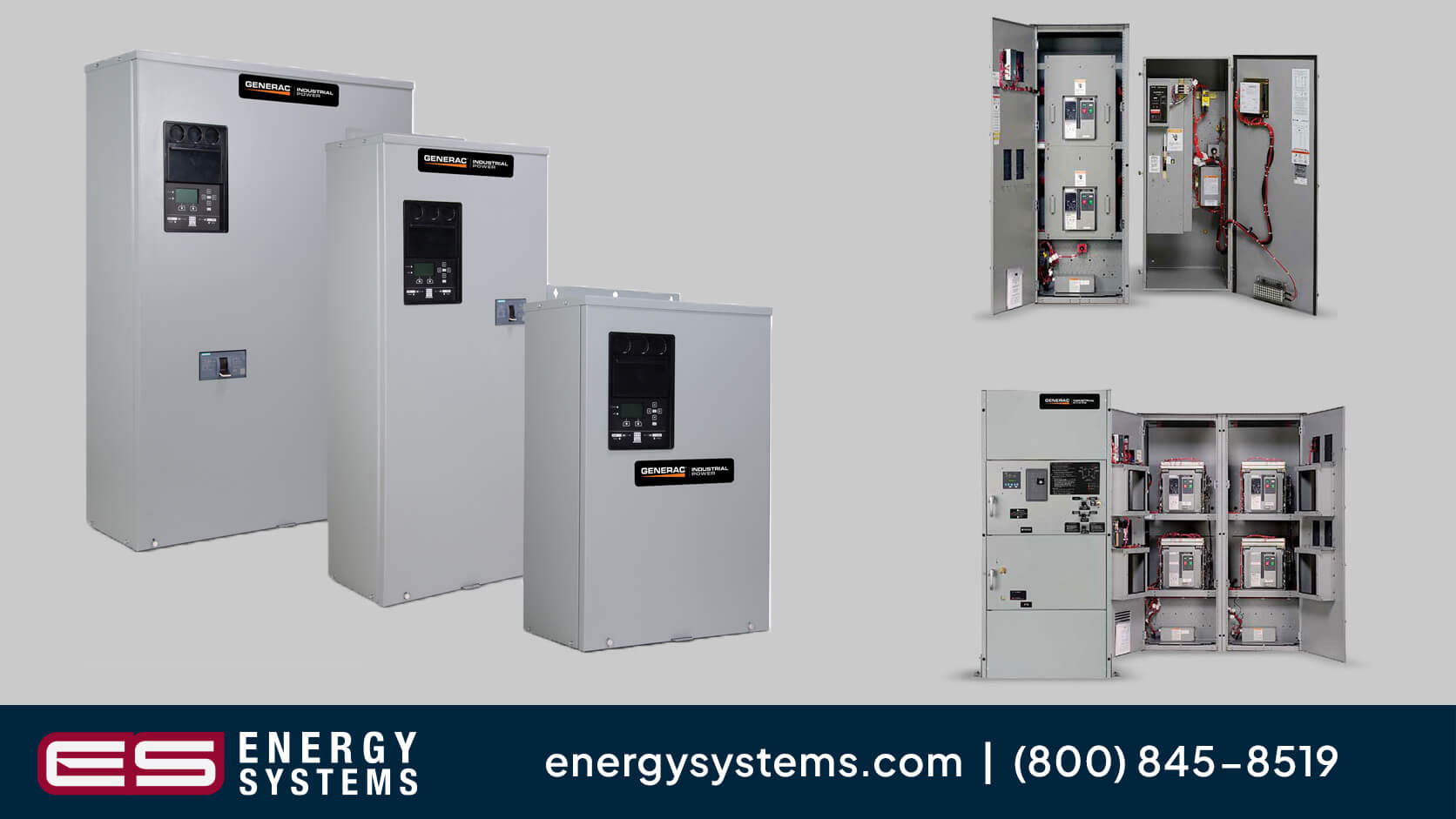
A transfer switch is a device used to transfer electrical power from one source to another.
The two sources can be similar (two utilities or two generators) or different (utility + emergency generator). The basic function of the switch is to ensure that the loads are always connected to an available — and preferably the most reliable — power source.
Because the transfer switch serves as the critical link between power sources, it is one of the most important components in a backup power system. It not only monitors the sources but also makes the decision of when and to which source to transfer the load.
The transfer switch controller continuously checks the voltage and frequency of the primary source. If it detects a failure or values outside acceptable limits, it verifies the secondary source is stable before transferring the load. In the case of a generator as the secondary source, the transfer switch sends the start signal to the generator and determines the safest time to make the transfer.
Selecting the right transfer switch for your application is essential for reliable and safe operation.
DETERMINING THE SYSTEM APPLICATION
The National Electrical Code (NEC) defines four categories of backup power systems:
- Emergency Systems (NEC Article 700)
Critical to life safety — egress lighting, fire pumps, elevators, ventilation, and communication systems. Common in hospitals, schools, and commercial buildings. - Legally Required Systems (NEC Article 701)
Systems deemed necessary by the Authority Having Jurisdiction (AHJ) to prevent hazards during outages (e.g., heating, refrigeration, smoke removal, sewage systems). Example: nursing home air conditioning in hot climates. - Critical Operations Power Systems (NEC Article 708)
Systems vital to national security, economy, or public safety (e.g., designated critical operation areas in government facilities). - Optional Standby Systems (NEC Article 702)
Not code-mandated — used for convenience in commercial buildings, farms, and homes.
UNDERSTANDING THE TYPES OF TRANSFER SWITCHES
- Manual Transfer Switch
Requires human operation (usually via a mechanical lever). Best for non-critical loads. - Automatic Transfer Switch (ATS)
Continuously monitors both sources and automatically transfers the load without human intervention. - Service Entrance Rated Transfer Switch
Includes the utility/service disconnect breaker in the same enclosure. Ideal for retrofits and simplifies installation. - Bypass Isolation Transfer Switch
Allows maintenance on the main transfer mechanism without interrupting power to the load. Commonly used in hospitals, data centers, and other critical applications.
WAYS TRANSFER SWITCHES TRANSITION LOADS
- Open Transition (Break-Before-Make)
Breaks from one source before connecting to the other. Brief power interruption occurs. - Open In-Phase Transition
Waits for both sources to be in sync before transferring. - Open Delayed Transition (Time Delay Neutral)
Includes a neutral position to allow motor loads to decay before connecting to the new source. - Closed Transition (Make-Before-Break)
Briefly connects both sources (usually <100 ms) so there is no interruption. Ideal for critical loads.
TYPES OF ENCLOSURES
- Type 1 — Indoor, basic protection
- Type 12 — Indoor, dust and light water splash protection (industrial environments)
- Type 3R — Rainproof, suitable for most outdoor installations
- Type 4 / 4X — Weatherproof and watertight (Type 4X is corrosion-resistant stainless steel — ideal for coastal areas)
CONCLUSION
Work with a consulting engineer and your local Generac distributor to select the right transfer switch for performance, code compliance, and budget. Proper sizing and professional installation are essential to avoid overloading and ensure long-term reliability.
Partnering with Energy Systems
Proper sizing and professional installation are essential to prevent overloading and ensure long-term reliability. At Energy Systems, our specialists are ready to help guide you through selecting the right transfer switch for your project's performance, code compliance, and budget requirements across an extensive service area that spans multiple regions of the United States. To see if your facility falls within our service footprint, please refer to our coverage map.
If you require professional assistance or have questions regarding transfer switch specifications, please contact Energy Systems at 1-800-845-8519.
Frequently Asked Questions (FAQ)
- Does Energy Systems provide transfer switch selection support in my area? Yes, we specialize in comprehensive power solutions across a wide service area in the United States, including expert guidance on selecting the appropriate transfer switch for your facility, as detailed in our coverage map.
- What is the benefit of a Bypass Isolation transfer switch? It allows for the maintenance or testing of the main transfer mechanism without requiring a power interruption to your critical loads, which is essential for facilities like hospitals.
- Who can I call for help with my generator transfer switch project? For professional guidance and support, contact Energy Systems at 1-800-845-8519.
ABOUT THE AUTHORS
Nikhil Nagpal joined Generac as a Product Manager in 2018. He is responsible for transfer switch product strategy and has over ten years of experience in the power generation industry. He holds an M.S. in Electrical Engineering from the University of Texas – Arlington.
Liz Burant is a Product Management Specialist at Generac Power Systems. A graduate of the University of Wisconsin-Platteville, she has been with Generac since 2011 and supports industrial and residential transfer switch development.